
Athanasios Vrantzas
ICT, Electrical and Electronic Engineering, Msc, Meng, Director of 6th Senior High school of Trikala, member of Scientific Association for the Promotion of Lifelong Learning (SAPLLe)
email: vrantzas@sch.gr
Abstract
The S.T.E.P.S. School Box, developed as Project Result 6 (PR6) within the Erasmus+ S.T.E.P.S. project, provides an open-access, multilingual, and highly integrated learning framework designed to modernize and democratize STEM education. Hosted openly as a Massive Open Online Course (MOOC) at moocsteps.eu, this digital ecosystem is built to guide diverse groups of learners—from primary school children to lifelong learners and educators—through specialized interdisciplinary pathways. This paper explores the strategic goals of Work Package 4 (WP4), the core thematic structure of its 25 specialized courses, the pedagogical integration of the low-cost, open-source FOSSBot robot, and the localization matrix that ensures regional accessibility across Europe. Furthermore, we present comprehensive evaluation data collected up to July 14, 2026, including platform analytics, an internal quality audit by 8 consortium experts, and field-testing feedback from 62 active classrooms and 20 intensive teacher audits. The paper demonstrates how visual physical robotics and virtual digital twins successfully lower technology anxiety, improve pedagogical clarity, and generate highly engaging «spark» moments that connect theoretical scientific concepts with tangible, real-world sustainability solutions. https://moocsteps.eu/
Keywords: S.T.E.P.S. School Box, educational robotics, open technologies, MOOC, STEM education, digital twin.
Introduction
Modern educational landscapes face significant challenges when integrating robotics and programming into everyday curricula: high costs of proprietary tech, lack of teacher confidence, and rigid educational frameworks that isolate technology from other disciplines. To systematically address these challenges, Work Package 4 (WP4) of the S.T.E.P.S. project serves as a key intervention designed to modernize, scale, and democratize STEM education across participating regions. WP4 directly aligns with core Erasmus+ priorities—specifically digital transformation, environmental sustainability, and inclusive education.
This intervention is built around three primary strategic goals:
1. Democratization of STEM: By replacing expensive, proprietary educational robotics gear and license-locked ecosystems with low-cost, open-source hardware (centered on the project’s custom FOSSBot platform) and free software, the project eliminates economic barriers for public and underfunded schools.
2. Teacher Empowerment: Providing localized, ready-to-use digital modules, alongside assembly and pedagogical guides, helps both pre-service and active secondary school educators easily introduce robotics, reducing technology-related anxiety even without prior programming experience.
3. Cross-Curricular Learning: Seamlessly blending coding and physical engineering with foundational school subjects like Math, Science, and Physics to bring abstract concepts to life, while maintaining a firm focus on environmental protection and sustainability.
This paper details the development, implementation, and rigorous field testing of the core deliverable of this work package: the S.T.E.P.S. School Box (PR6).
The Core Deliverable: S.T.E.P.S. School Box (PR6)
The primary output of WP4 is Project Result 6 (PR6): The S.T.E.P.S. School Box, an inclusive and scalable learning hub hosted openly at moocsteps.eu. Designed as a Massive Open Online Course (MOOC), it supports self-paced or instructor-led learning pathways for users ranging from primary students to adult learners.
A. Thematic Structure & Interdisciplinary Learning
The platform includes 25 specialized, highly rigorous courses structured to break down silos between academic disciplines. These courses are divided across four main thematic pillars:
• Programming & Robotics (7 Modules): Establishes foundational computational thinking and core programming paradigms. It utilizes block-based visual coding environments to teach modules such as «Draw with Code! (Geometric Shapes)» to master loops and angles, «Time-controlled movement with colours» to understand state-machines and RGB LED actuators, «Measuring velocity» to map physical gear rotations to virtual variables, and the «Observation Game» to develop event-driven programming.
• Environmental Applications & Sustainability (6 Modules): Directly bridges technical engineering workflows with practical ecological ethics, showing students how robotics can solve environmental crises. Key modules include «Smart Lighting for Environment & Safety» to optimize electrical grid usage, «Environmental Patrol» where robots detect ambient changes and pollutants, «FOSSBot Waste Warriors» introducing automatic recycling sorting logic, and «Solar Oven» which teaches principles of thermodynamic modeling and solar tracking using photoresistors.
• Technology Integration in Education (6 Modules): Cultivates practical operational workflows to easily weave hardware into daily classroom structures. It includes «Green S.T.E.P.S. with FOSSBot» as a guide for using eco-friendly materials, «Navigation through Traffic» to simulate smart municipal infrastructure and autonomous vehicles, «Discovery & Use of Ultrasonic Sensors» to teach the physics of sound reflection and distance calculation, and the «Carbon Footprint Tracker» to model and calculate real-time energy consumption.
• Engineering Principles & Practices (6 Modules): Explores physical mechanics, kinetics, and structural design challenges. This features «Edge detection & safe robot navigation» utilizing infrared sensors to prevent falls, «From Relative to Absolute positions» to teach Cartesian coordinate systems and spatial telemetry, «Probability Adventure with FOSSBot» demonstrating mathematical randomness, and «Sustainable Road Transport Management» to teach optimal route planning to reduce fuel and energy waste.
To ensure maximum sustainability, all curricular guides, multimedia content, quizzes, and software scripts are published as Open Educational Resources (OER) under Creative Commons licenses (CC BY-NC-SA), allowing educators to freely download, modify, and re-distribute the material indefinitely.
B. Hardware Driver: The FOSSBot & its Digital Twin
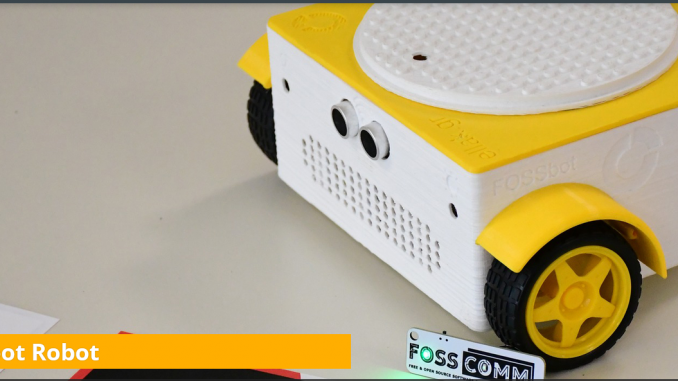
The physical and virtual centerpiece of the School Box is the FOSSBot—an open-source educational robot designed collaboratively by educational, research, and open-source experts. The FOSSBot’s chassis is completely 3D-printable to reduce manufacturing costs and plastic waste, while its bill of materials (BOM) relies on low-cost, off-the-shelf microcontrollers and sensor units. Functioning as a hands-on pedagogical bridge, it allows students to visually see abstract programming logic, physical kinematic equations, and mathematical calculations manifest directly in the robot’s physical movements.
For schools lacking physical hardware resources, FOSSBot features a fully synchronized «digital twin» simulation. This web-based virtual simulator runs the exact same code on a virtual model of the robot, ensuring maximum equity, safety, and accessibility both in the lab and at home.
C. Localization Matrix
To ensure seamless integration across highly diverse European school networks, the platform provides deep, context-aware localized user interfaces, menus, lesson frameworks, and software code comments translated by educational experts for five primary language regions:
• EN: Pan-European Dissemination and international school networks.
• FR: France, adapted for national educational frameworks and curricula.
• ES: Spain, aligning with regional educational laws and linguistic requirements.
• TR: Turkey, customized to meet local secondary school technical standards.
• EL: Greece, integrated directly with Greek school networks and national STEM organizations.
Dissemination Milestones & Platform Traction
A major milestone in spreading the project’s reach was Multiplier Event 4 (E4), titled «S.T.E.P.S. School Box: An Open Digital Environment for STEM Education».
• Host & Date: Organized virtually via the Zoom platform by the lead partner, the Scientific Association for the Promotion of Lifelong Learning (SAPLLe), on Monday, April 27, 2026, from 16:00 to 18:00 CET.
• Language & Audience: Conducted in both Greek and English, attracting 78 external participants, including primary and secondary school teachers, adult trainers, university pre-service teacher-training students, STEM researchers, and academic policymakers.
• Event Outcomes: The webinar served as the official public launch of the moocsteps.eu platform, providing a thorough pedagogical walkthrough. Transnational educators demonstrated four localized classroom implementation scenarios from Greece, France, Spain, and Turkey, proving that teachers can immediately deploy these activities without needing any prior computer science background.
Following localized rollout events, platform analytics collected between March and July 2026 showcased strong initial deployment traction:
• Total Page Views: 1,128 page views.
• Total Sessions: 486 active user sessions, indicating repeat visits and sustained learning periods.
• Unique Visitors: 345 individual registered learners and guest educators.
• Geographic Traffic Share: Greece led with 82.4% of traffic, followed by Turkey (5.3%), France (3.9%), Brazil (2.4%), United Kingdom (2.0%), Spain (1.0%), and miscellaneous global hits.
Evaluation Data & Field-Testing Metrics
A. Internal Quality Review (Consortium Experts)
An audit conducted by 8 internal partner experts gave outstanding marks across all development categories:
• Consortium Cooperation and Potential Impact scored the highest, dominated by Outstanding (5) ratings, highlighting successful cross-border collaboration and a strong belief in the project’s long-term structural influence.
• Methodological Quality and Degree of Innovation met or exceeded expectations, concentrating heavily in the Exceeds Expectations (4) tier, validating the pedagogical combination of open hardware and sustainability-focused educational modules.
The evaluation concluded that the S.T.E.P.S. project successfully delivers high-quality educational resources that closely align with the objectives outlined in the project proposal. The ratings reflect the strong consistency between the School Boxes, the FOSSbot activities, and the Moodle-based MOOC platform.
Refinement Suggestions
The experts identified several practical enhancements to further improve quality:
1. Adding short video walkthroughs of learning scenarios and FOSSBot activities to better support teachers with limited experience in robotics.
2. Introducing competency-based evaluation tools, such as rubrics and student self-assessment checklists, to complement existing quizzes.
3. Making age-specific learning pathways and progression levels (e.g., beginner, intermediate, advanced) more visible within platform navigation.
4. Further standardizing the structure of lesson plans and expanding STEM topics.
B. Field-Testing Implementation
When deployed directly within active classrooms, feedback loops from 62 implementing classrooms and 20 intensive teacher audits provided highly encouraging metrics:
• Subject Support: The materials were rated «Highly Effective» (Score 5) by an absolute majority for Information Technologies and Physics, proving that visual physical robotics simplifies complex, abstract concepts. Math split its ratings between Neutral and Highly Effective, suggesting a solid foundation with minor adjustments needed to better tie algorithmic loops with school arithmetic.
• Pedagogical Clarity: 72.9% of educators rated the flow of the provided Lesson Plans as excellent (scoring them a 4 or 5), proving that the step-by-step structures significantly lower the lesson preparation times for teachers.
• Ease of Adoption: 55.6% of audited teachers rated the platform a 4 or 5 for user intuition, confirming it delivers an immediate, low-barrier entry point for non-expert educators with zero previous programming experience.
• Infrastructure Fit: The vast majority of teachers reported that the setup matched their existing equipment easily without requiring extra school budget, demonstrating that the platform’s virtual simulators and low-cost hardware approach mesh perfectly with typical school classrooms.
Perspectives from the Classroom: The «Spark» Moments
The qualitative feedback collected during field testing emphasizes the transformation of the student experience from passive listening to active engagement.
An overwhelming majority of students recognized the FOSSBot as a valuable learning facilitator rather than a distraction, noting that the robot turned boring coding logic into an engaging «living experiment».
Teachers reported that student engagement was vastly superior to traditional STEM lessons, describing a state of «flow» where students actively managed their own knowledge. Key «spark» moments identified by educators include:
• The Screen-to-Reality Bridge: The exact moment the FOSSBot successfully executed its first «obstacle avoidance» command. Seeing the abstract logic of an if-then statement manifest as a physical movement—where the robot «decided» to turn before hitting a wall—transformed coding into a tangible superpower.
• Cross-Curricular Problem Solving: During the Engineering and Smart Cities session, students used FOSSBot’s light sensors to simulate an automated street lighting system. The trigger occurred when they used a simple mathematical threshold to define «sunset» for their robot. Dimming the classroom lights to watch all their bots” LEDs flicker on simultaneously showed them how Physics (optics) and Math (threshold values) could solve real-world environmental problems.
• Active Manipulation and Discovery: Students experimenting with Scratch projects quickly moved from following instructions mechanically to testing creative ideas. When one student realized how changing a single block altered a sprite’s behavior, curiosity took over. The «spark» was triggered by a sense of control and creativity, shifting their questions from «Is this right?» to «I wonder what happens if I do this?».
Conclusion
The S.T.E.P.S. School Box (PR6) successfully demonstrates that educational robotics can be made accessible, inclusive, and cross-curricular without losing pedagogical depth. By combining the physical FOSSBot, its virtual digital twin, block-based programming, and age-differentiated sustainability modules, the project provides a robust, scalable, and sustainable educational ecosystem. The platform’s strong initial analytics, positive internal expert reviews, and encouraging classroom feedback confirm that the School Box delivers on its promise of a low-barrier, highly effective entry point for modern STEM education.
Acknowledgements
The S.T.E.P.S. School Box was developed within the framework of the Erasmus+ S.T.E.P.S. project (Project Reference: 2023-1-FR01-KA220-HED-00016571). The work reflects the joint contributions of the consortium partners (SAPLLe, UBU University, GFOSS, APDNE) and the broader open-source educational robotics community.
References
• Chronis, K., Mamatnabiyev, J., & Alimisis, D. (2024). FOSSBot: An Open Source and Open Design Educational Robot for Coding and Computational Thinking. Journal of Open Technology in Education, 12(2), 45–59.
• European Commission. (2024). Digital Education Action Plan (2021-2027): Resetting education and training for the digital age. European Schoolnet Ecosystems.
• Mamatnabiyev, B., Chronis, K., & Standardi, A. (2025). Integrating IoT Technologies for Remote Control, Computer Vision, and Sensing in Tertiary Education Robotics. International Journal of Computer Science Education, 19(4), 112–128.
• S.T.E.P.S. Consortium. (2026). Erasmus+ Project Result 6 (PR6): S.T.E.P.S. School Box Platform and Open Educational Resources (OER) Development Framework. S.T.E.P.S. Core Hub.
• Thinh, D. P., Manzoor, S., & Al-Ahmadi, M. (2026). Development of an Educational Robotic Platform with Dual Control Interfaces and Intelligent Computer Vision-Based Interaction. FME Transactions, 54(1), 94–102.
• UNESCO. (2025). Open Educational Resources (OER) Implementation Guidelines for Digital Inclusion and Equitable Accessibility. UNESCO Digital Library Ecosystem.
